

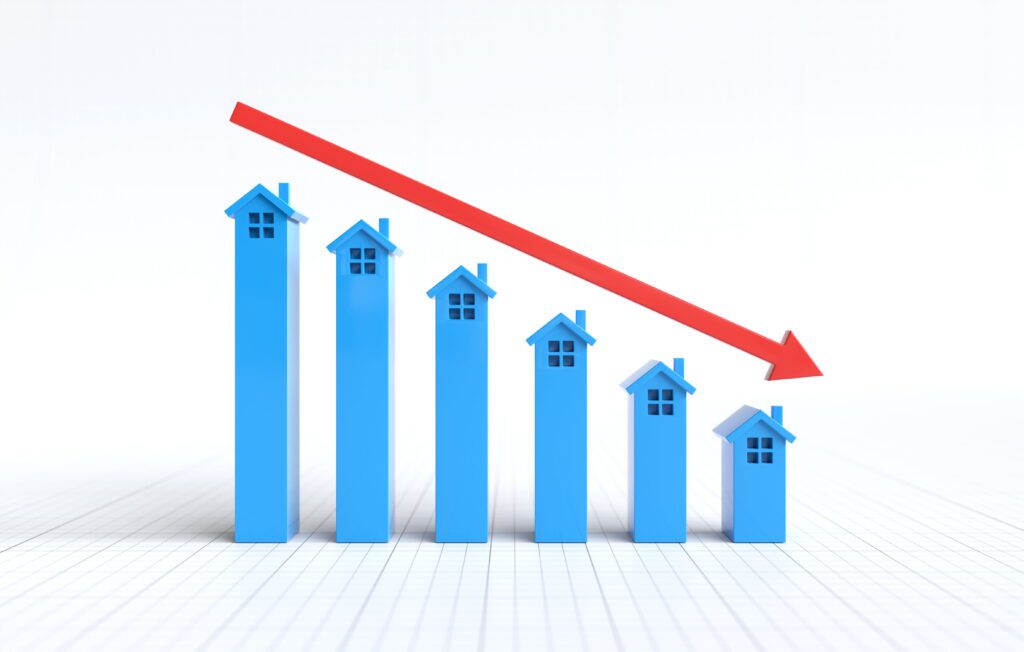
If you’ve seen the recent headlines, you already know the number. The Fraser Valley Real Estate Board says benchmark home prices in the region are down 26% from where they sat in 2022, with the June 2026 composite benchmark sitting just under $885,000, about 7% lower than a year ago. Sales were flat, with 1,147 transactions on the MLS in June, up slightly from May but still down 4% from the same month last year.
For anyone who owns a house in Surrey or Langley, that’s a meaningful headline. For anyone who owns a farm or acreage in the Fraser Valley, it’s a more complicated one, and it’s worth pulling apart before you draw any conclusions about your own property.
What the Numbers Actually Cover
The FVREB benchmark figures break down by housing type. Single detached homes came in at $1.35 million in June, down 7.7% year-over-year. Townhouses sat at $764,000, down 7.3%. Apartments saw the sharpest drop, falling 9.1% year-over-year to $476,400.
Here’s the part that matters for farm owners: these benchmarks are built from residential sales data. They track single-family homes, townhouses, and condos across the Fraser Valley’s urban and suburban neighbourhoods. They do not track ALR farmland, acreage properties, or agricultural operations as a separate category. A working blueberry farm in Abbotsford or a horse property in Langley doesn’t move through the same buyer pool, the same financing process, or the same valuation logic as a townhouse in Cloverdale.
That distinction gets lost fast in casual conversation. A seller hears “prices are down 26% from the peak” and assumes their farm has lost the same ground. A buyer hears the same thing and assumes acreage is now 26% cheaper to acquire. Neither assumption holds up well once you look at how farm and acreage properties are actually priced.
Why Farm and Acreage Value Doesn’t Track the Residential Benchmark
A farm’s value is built from several layers, not one number. Soil class and usable acreage. Water access and drainage. Existing crop income or operating history. ALR status and what it does or doesn’t allow. Barns, shops, greenhouses, and other infrastructure. Road frontage and access. And yes, the home itself, but as one component among several, not the whole equation.
Because of that, farm and acreage pricing tends to move on its own timeline. Land with strong soil, clean water rights, and real agricultural income can hold value even while general housing sentiment softens. A property with access issues, floodplain exposure, or unclear ALR standing can struggle to sell even in a strong market. The residential benchmark is a useful signal for overall buyer confidence in the region, but it’s a poor substitute for an actual farm valuation.
What This Means for Sellers
If you’re a farm or acreage owner in the Fraser Valley thinking about listing, the FVREB report is worth understanding for one reason: it tells you something about buyer psychology, not about your land’s worth. FVREB CEO Baldev Gill noted that buyers are still holding back despite improving conditions, and board chair Ishaq Ismail put it plainly: the spring market underperformed expectations even with better affordability and more choice on the table.
That kind of hesitation tends to spill across the whole market, including acreage buyers who are watching the news and feeling cautious even when a specific property is well priced. For sellers, this matters because pricing a farm off a residential benchmark, high or low, almost always misses the mark. The right approach starts with understanding what buyers in today’s market are actually paying for on a property like yours: the land, the water, the infrastructure, the income potential, or the future estate-home value. That’s a different exercise than checking what a detached home sold for down the road.
What Buyers Should Watch For
For buyers, a softer general market can mean more patient sellers, more room to negotiate, and more time to do proper due diligence before removing subjects. That’s a real advantage if you’re looking at a farm or acreage purchase this year.
The catch is that “the market is down 26%” doesn’t tell you anything about whether a specific ALR parcel is fairly priced. Before making an offer, buyers should still confirm zoning, water access, drainage, easements, and ALR use restrictions, and should understand whether the price reflects the land’s agricultural potential or is anchored to a residential comparison that doesn’t really apply. A lower general market doesn’t remove the need for that homework. If anything, it makes it more valuable, because sellers who understand their land well are the ones most likely to hold a fair price regardless of what the residential benchmark is doing.
The Local Picture for Landowners
Across Langley, Abbotsford, Chilliwack, and Surrey, the pattern we’re seeing lines up with what the board describes: steady interest, cautious buyers, and sellers who need a clear, land-specific case for their price rather than a headline number. Farm and acreage transactions in this region have always run somewhat independent of the broader residential cycle, and that continues to hold true in a market described as sluggish.
Final Thoughts
Headlines about a 26% price drop are useful context, but they’re not a valuation tool for a farm or acreage property. If you’re weighing a sale or a purchase this year, the better question isn’t what the residential benchmark did since 2022. It’s what your specific land, water, infrastructure, and agricultural potential are actually worth right now.
If you’re considering buying or selling a farm or acreage in the Fraser Valley, Farms In BC can walk you through what your property, land, and infrastructure are really worth in today’s market, separate from residential headlines. Contact Nav Sekhon at 604-782-0988 for a confidential farm and acreage market evaluation.